Dry-Down Studies and Yield Results
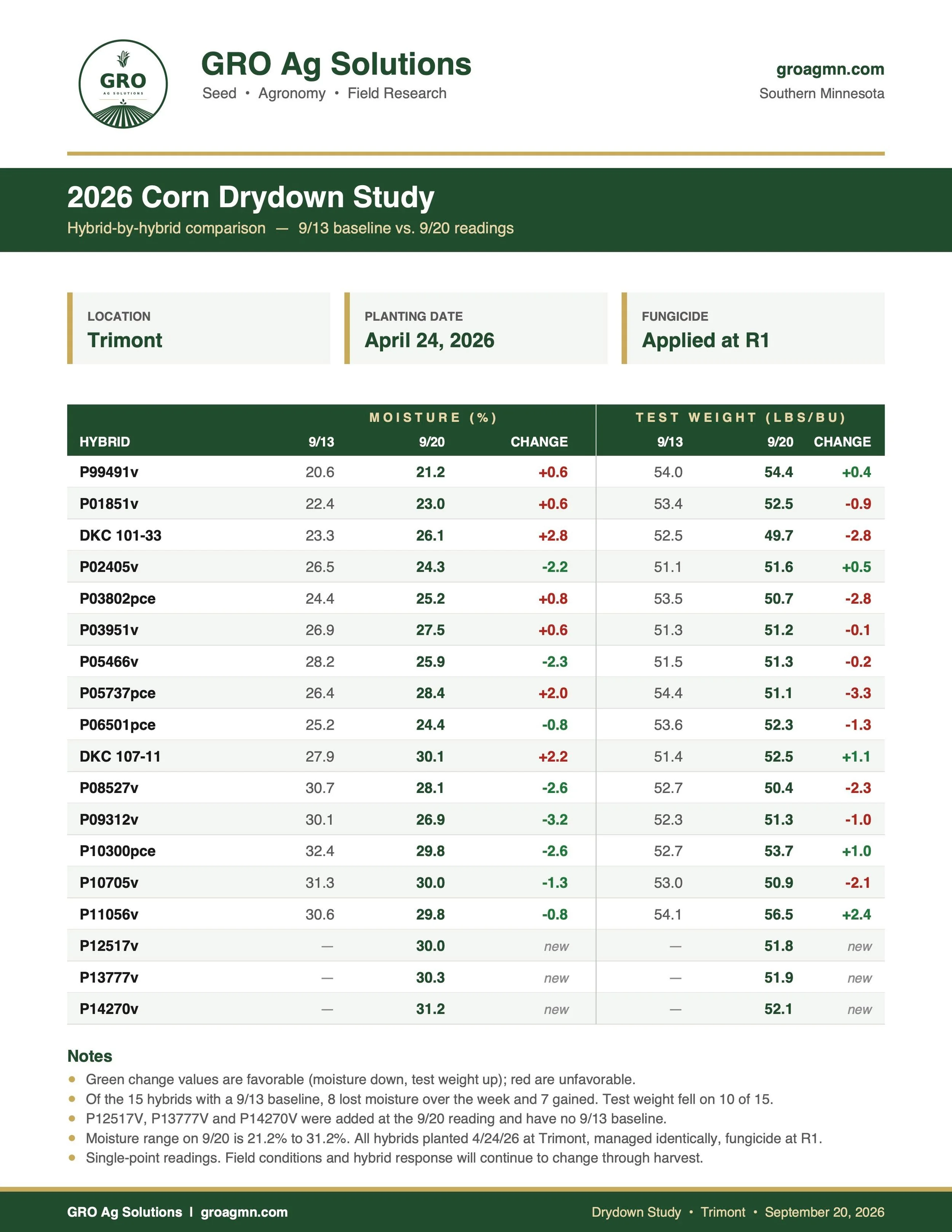
We will be doing the corn dry-down study every week for 4-5 weeks starting Sept. 13th. We will post and send yield updates and plot results as we complete them!
Why Corn Drydown Updates Matter for Southern Minnesota Farmers
For Southern Minnesota corn growers, harvest timing is a financial decision as much as an agricultural one. Frequent corn drydown studies provide current, local information about how quickly grain is losing moisture in the field. That information can help farmers control drying costs, schedule harvest equipment, protect grain quality, and make better use of on-farm storage.
Southern Minnesota sits near the northern edge of the traditional Corn Belt, where fall weather windows can narrow quickly. Corn may dry relatively quickly during warm September days, then slow dramatically as temperatures decline, skies cloud over, and wet weather arrives. Regular moisture checks give farmers a clearer picture of whether to wait for field drying or begin harvest and rely on mechanical drying.
Understanding Corn Drydown Rates
After corn reaches physiological maturity, grain begins to lose moisture naturally in the field. The rate varies by weather, hybrid, planting date, field conditions, and plant health.
As a general guide, corn may dry by roughly 0.75% to 1.0% per day in mid-September. By mid-October, drydown often slows to about 0.25% to 0.5% per day, and can slow even further later in the season. These estimates are useful for planning, but local field measurements are more valuable because actual conditions can vary widely.extension.umn
For example, a field testing at 21% moisture in late September may reach 18% in several favorable drying days. But a cold front, rain, or cloudy weather can change that projection quickly. Frequent drydown updates help farmers make decisions based on current conditions rather than assumptions.
1. Reducing Propane and Drying Costs
Artificial drying is one of the largest variable expenses during corn harvest. Harvesting wetter corn may help avoid field losses or weather delays, but it also increases the amount of fuel, time, and equipment capacity needed to prepare grain for storage.
Corn intended for long-term storage is commonly dried to about 13% to 15% moisture. Allowing corn to dry naturally in the field can reduce the need for propane or commercial drying, provided crop conditions and the weather forecast allow it.
Frequent drydown data helps farmers weigh the value of waiting a few days against the cost and risk of delay. If a field is drying steadily and has strong stalks, waiting may reduce drying expense. If colder weather, lodging risk, or rain is approaching, harvesting earlier may be the more economical choice even at a higher moisture level.
Drydown monitoring also helps prevent overdrying. Removing moisture below what is needed for safe storage means less saleable grain weight and unnecessary energy use.
2. Prioritizing Fields and Hybrids
Few farms have just one field or one hybrid ready at the same time. Different planting dates, maturity ratings, soil types, disease pressure, and weather exposure all affect when corn reaches harvestable moisture.
Regular drydown studies help create a more strategic harvest queue. Instead of choosing fields based only on planting order or visual appearance, farmers can compare actual moisture levels and drying trends across the operation.
A useful harvest priority may include:
Fields with weak stalks or elevated lodging risk
Corn affected by disease or late-season stress
Hybrids that are drying more slowly than expected
Fields nearing the moisture level best suited to available drying or storage systems
Fields with the strongest opportunity to reduce artificial-drying costs
Stalk condition can be as important as moisture. A field with slightly wetter grain but weak stalks may need to be harvested before a drier field that can safely remain standing. University of Minnesota Extension recommends evaluating vulnerable fields for stalk strength, because lodging can create greater losses and slow harvest significantly.
3. Protecting Grain Quality
Corn moisture affects how grain moves through the combine, handling equipment, dryers, and storage bins. Very wet kernels can be more susceptible to cracking and damage during harvest and handling. Broken kernels and fines can reduce grain quality, limit airflow in storage, and contribute to spoilage problems.
Frequent moisture checks allow farmers to adjust harvest plans and combine settings as grain conditions change. Rather than relying on one reading from earlier in the week, crews can respond to the moisture level of the specific field being harvested.
Good grain-quality management includes checking for cracked kernels and fines, calibrating equipment, and cleaning grain before storage when practical. Removing fines is particularly important for natural-air drying, where even airflow through the grain mass is essential.
4. Making Better Use of Natural-Air Drying
Natural-air drying can be a cost-effective storage strategy for many Upper Midwest farms. Rather than using high-heat burners, the system uses fans to push ambient air through stored corn.
However, natural-air drying only works well when incoming corn moisture matches the airflow capacity of the bin. For a typical system, corn in the 21% to 22% moisture range is often a more manageable target. Wetter corn can be stored safely only when the bin has enough airflow and the drying system is managed carefully.extension.umn
Frequent drydown reports help farmers identify when fields are approaching the moisture range that fits their storage system. This supports better decisions about when to start combining, how to allocate bin space, and whether supplemental heat or commercial drying may be needed.
Natural-air bins also require active management. Farmers should monitor stored grain for temperature changes, odors, mold, and moisture problems, especially near the top of the bin. Quick action can prevent small issues from becoming costly spoilage losses.
Frequently Asked Questions
-
Corn may lose roughly 0.75% to 1.0% moisture per day in mid-September. By mid-October, drydown commonly slows to about 0.25% to 0.5% per day. Actual rates depend on temperature, sunlight, humidity, rainfall, hybrid characteristics, and field conditions.
-
Corn intended for long-term storage is commonly dried to about 13% to 15% moisture. Grain stored above that range requires careful drying and management to reduce the risk of spoilage.
-
No. Waiting can reduce artificial-drying costs, but it can also increase the risk of lodging, disease-related losses, weather delays, and slow drydown in late season. The right decision depends on the field’s moisture, stalk condition, forecast, drying capacity, and storage options.
-
It can, but only if the storage system provides enough airflow for the moisture level. Many natural-air systems work best with corn around 21% to 22% moisture, while higher-airflow systems can safely handle wetter corn with close monitoring
Better Data, Better Harvest Decisions
Corn drydown studies do not eliminate harvest uncertainty. They give farmers a better way to manage it.
When paired with weather forecasts, field scouting, stalk evaluations, dryer capacity, storage plans, and delivery schedules, frequent moisture information can help Southern Minnesota growers reduce costs and prioritize risk. The goal is not simply to harvest the driest corn possible. It is to harvest each field at the point that best balances drying expense, grain quality, storage capacity, field condition, and weather risk.
In a short and unpredictable fall season, current drydown data helps turn harvest decisions from educated guesses into a more informed operating plan.